
Complete Guide to Access Control Systems for Businesses in Oman
Walk into almost any modern office building in Muscat, Salalah, or Sohar today, and you’ll notice something: very few doors still open with a traditional key. Instead, employees tap a card, scan a fingerprint, or glance at a camera before walking through. This shift isn’t just a trend – it’s a response to how Oman’s business landscape has changed.
As the Sultanate continues to diversify its economy under Oman Vision 2040, more companies are opening offices, warehouses, retail outlets, and industrial facilities across the country. With growth comes a new set of security and operational questions: Who is walking through your doors? When are they coming in and leaving? And how do you protect valuable assets, sensitive data, and your people without slowing everyone down?This is exactly the gap that access control systems fill. If you’re a business owner, facilities manager, or IT decision-maker exploring this topic for the first time, this guide walks you through everything you need to know – in plain language, with no unnecessary jargon.
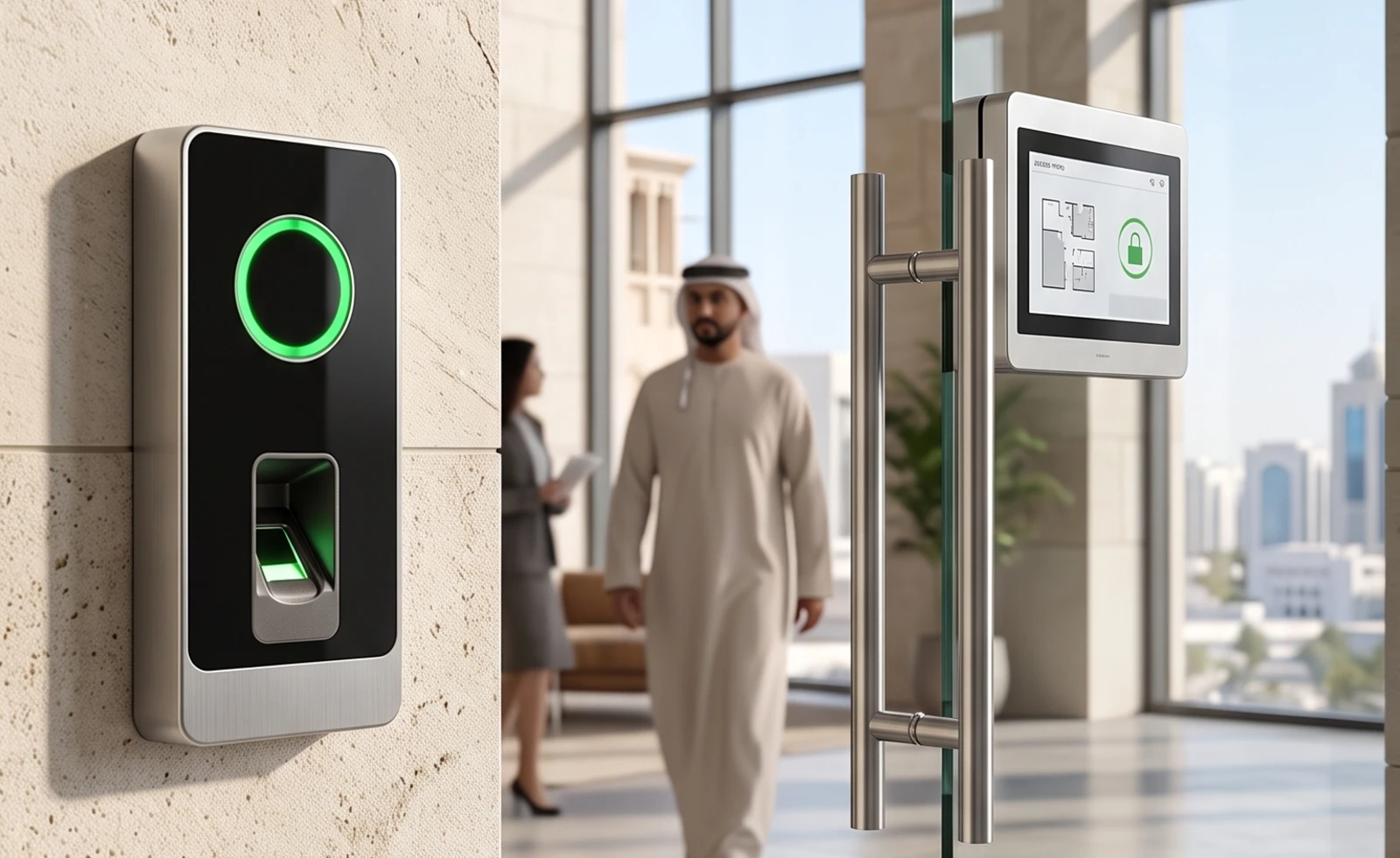
What Is an Access Control System?
An access control system is a security setup that decides who can enter a building, room, or restricted area – and when. Instead of relying on a metal key that anyone can copy or lose, these systems use digital credentials such as smart cards, PIN codes, mobile phones, or biometric data (like a fingerprint or face scan) to verify identity before granting entry.
At its core, every access control system has three parts:
- A credential – something the person presents (a card, code, fingerprint, or app).
- A reader or scanner – the device mounted at the door that checks the credential.
- A controller and software – the “brain” that decides whether to unlock the door and keeps a record of every entry attempt.
Put together, these components give a business complete visibility and control over its physical premises – something a lock and key simply cannot offer.
Why Access Control Matters for Businesses in Oman Right Now
Oman’s business environment in 2026 looks very different from a decade ago. Free zones, industrial estates, and commercial towers are expanding across Muscat, Duqm, and Sohar, and companies are managing larger teams, multiple entry points, and higher-value assets than ever before.
A few reasons access control has become a priority rather than an afterthought:
- Traditional keys are a weak link. Keys get copied, lost, or handed to the wrong person, and once that happens, you often have to rekey entire buildings.
- Insurance and compliance expectations are rising. Many insurers now look favorably on businesses with documented, electronic security measures, and some regulated sectors require access logs as part of compliance.
- Workforces are more mobile and diverse. With staff working varied shifts across warehouses, offices, and job sites, businesses need a reliable way to track who is on-site at any given moment.
- Theft and unauthorized access carry real costs. Beyond stolen goods, a security breach can mean lost data, damaged reputation, and disrupted operations.
- Remote and multi-branch management is now expected. Business owners with several locations want to manage access permissions from one dashboard rather than visiting each site physically.
Put simply, businesses that still rely purely on physical keys are carrying a level of risk that most modern companies no longer need to accept.
Types of Access Control Systems Available in Oman
Not every business needs the same setup. Here’s a breakdown of the main technologies available to Omani companies today, from the most basic to the most advanced.
1.PIN Code / Keypad Systems
Users enter a numeric code to unlock a door. This is the most affordable option and works well for small offices or single-entry storage rooms. The downside is that codes can be shared or observed by someone standing nearby.
2. Card and Fob-Based Systems
Employees carry a proximity card or key fob that they tap against a reader. This method is widely used across Omani offices, retail outlets, and residential compounds because it’s affordable, easy to manage, and simple for staff to understand. The main limitation is that cards can be lent out or lost.
3. Biometric Access Control
Biometric systems verify a person using a unique physical trait – most commonly a fingerprint, face scan, or, in high-security environments, a palm vein pattern. Because a fingerprint or face cannot be borrowed or duplicated the way a card can, biometric readers have become increasingly common in Omani offices, warehouses, hospitals, and educational institutions. They’re especially useful for eliminating “buddy punching” – where one employee clocks in on behalf of a colleague who hasn’t yet arrived.
Fingerprint readers are fast and cost-effective but can struggle with worn or dry skin, which is a factor worth considering for outdoor or manual-labor workforces. Facial recognition readers work well in high-traffic entrances and offer a touch-free experience, though the reader’s accuracy across different lighting conditions and skin tones should be tested against your actual staff before you commit to a vendor.
4. Mobile Credential and Cloud-Based Systems
Instead of a physical card, employees use an app on their smartphone – via Bluetooth or NFC – to unlock doors. Cloud-based platforms also let managers add or remove access permissions remotely, which is particularly useful for businesses with several branches across Oman.
5. Multi-Factor Systems
For higher-security areas such as server rooms, finance departments, or pharmacy storage, many businesses combine two methods – for example, a card plus a fingerprint scan. This adds an extra layer of protection without slowing down general entry points.
Key Benefits for Omani Businesses
- Stronger security by removing the risks associated with shared or stolen keys.
- Accurate time and attendance tracking, reducing payroll disputes and eliminating buddy punching.
- Detailed audit trails showing exactly who entered which area and when – valuable during incident investigations.
- Remote management, letting owners with multiple branches oversee access from a single dashboard.
- Better visitor management, with temporary credentials that automatically expire.
- Long-term cost savings, since you avoid the recurring expense of rekeying locks every time a card or key goes missing.
- Scalability, allowing you to add new doors, users, or locations as your business grows, without replacing the whole system.
Industries in Oman That Benefit Most
While almost any business can benefit from access control, certain sectors see the fastest return on investment:
- Corporate offices and business towers – managing staff and visitor flow across multiple floors.
- Warehouses and logistics hubs – protecting inventory and tracking shift workers.
- Healthcare facilities – restricting access to pharmacies, labs, and patient records areas.
- Educational institutions – securing campuses while monitoring student and staff movement.
- Retail chains and hospitality venues – controlling back-of-house areas and cash rooms.
- Government and regulated entities – meeting compliance and audit requirements.
For companies managing shift-based or hourly staff, time and attendance access control services in Oman have become one of the most requested features, since they directly reduce payroll errors and eliminate manual timesheet tracking.
What to Look for Before You Choose a System
Selecting the right setup isn’t only about picking the newest technology – it’s about matching the system to how your business actually operates. Keep these factors in mind:
- Throughput needs. How many people pass through your busiest entrance during peak hours? A single reader at a 300-person entrance will create bottlenecks.
- Integration capability. Your access control system should ideally connect with your CCTV, fire alarm, and HR software so that events (like a forced door or an employee’s last working day) trigger the right automated response.
- Data storage and privacy. If you’re deploying biometric readers, ask where the data is stored, how it’s encrypted, and how it’s deleted once an employee leaves.
- Fail-safe compliance. All access-controlled doors must unlock automatically during a fire alarm – this is a safety requirement, not optional.
- Local support and after-sales service. A system is only as good as the support behind it. Choose a provider with local technicians who understand Oman’s climate, building codes, and infrastructure.
- Scalability. Choose a platform that can grow with your business rather than requiring a full replacement in two years.
Businesses researching access control solutions in Oman should treat this evaluation stage seriously – a rushed decision here often leads to costly upgrades later.
Common Mistakes Businesses Make
- Choosing the cheapest reader without checking its accuracy specs. A poor-quality biometric reader can either let unauthorized people in or repeatedly reject legitimate staff.
- Skipping proper enrolment. A rushed fingerprint or face scan during setup leads to ongoing recognition problems.
- No backup plan for system failure. Every deployment needs a secure fallback process for when a reader malfunctions.
- Ignoring future growth. Installing a system sized only for today’s headcount often means paying for a second installation within a few years.
- Overlooking local expertise. Working with an installer unfamiliar with Oman’s regulatory and environmental conditions can lead to avoidable issues down the line.
Providers such as Meridian IT Solutions work directly with businesses across Oman to assess these factors upfront – from site surveys to system design – helping companies avoid the trial-and-error approach that often drives up costs.
Installation and Cost Considerations
Costs vary widely depending on the number of doors, the technology chosen, and whether the system needs to integrate with existing infrastructure. As a general guide:
- Basic card/PIN systems for a single entry point are the most budget-friendly option, suited to small offices.
- Biometric systems cost more upfront but often pay for themselves within 6–12 months through reduced time theft and administrative overhead.
- Multi-door, multi-branch, cloud-managed systems carry a higher initial investment but offer the strongest long-term scalability and control.
It’s worth requesting a site survey rather than a generic quote – the layout of your building, door types, and existing wiring all affect the final installation cost.
Final Thoughts
Access control is no longer a “nice to have” for businesses in Oman – it’s a foundational part of running a secure, efficient, and scalable operation. Whether you’re a small office looking to move past traditional locks or a growing enterprise managing multiple branches, there’s a system that fits your needs and budget.
The right approach is to start with your actual requirements – how many doors, how many people, what level of security – and then work with an experienced local provider who can design a system around those realities rather than a one-size-fits-all package.
Frequently Asked Questions
What is the difference between access control and a CCTV system?
Access control decides who can physically enter a space and records that entry. CCTV records what happens visually. Many businesses use both together, with access events triggering nearby cameras for a complete security picture.
Is biometric access control legal for businesses in Oman?
Yes, but businesses should obtain informed consent from employees before enrolling their biometric data, store it securely, and have a clear policy for deleting it once someone leaves the company.
How much does an access control system cost for a small office in Oman?
Costs depend on the number of doors and the technology used. A basic card or PIN-based system for a single door is the most affordable starting point, while biometric and multi-door systems require a larger investment.
Can access control systems integrate with time and attendance tracking?
Yes. Most modern systems, including biometric readers, can automatically log employee check-in and check-out times, removing the need for manual timesheets and reducing payroll disputes.
What happens to access control doors during a fire emergency?
All access-controlled doors are required to unlock automatically when a fire alarm is triggered, allowing safe evacuation regardless of the system’s normal access rules.
Which type of access control is best - card, PIN, or biometric?
It depends on your security needs and workforce. Cards are simple and affordable, PINs are the most budget-friendly, and biometrics offer the highest accountability since credentials can’t be shared. Many businesses combine two methods for extra security.
Can one access control system manage multiple office branches in Oman?
Yes. Cloud-based access control platforms allow business owners to manage permissions, monitor entry logs, and add or remove users across multiple locations from a single dashboard.
How long does installation typically take?
A single-door system can often be installed within a day, while multi-door or multi-branch deployments may take several days to a few weeks, depending on wiring, integration needs, and building size.
Do access control systems work during a power outage?
Most professionally installed systems include battery backup for controllers and doors, ensuring continued operation or a safe fail-open/fail-secure state during short power interruptions.
How do I choose a reliable access control provider in Oman?
Look for a provider with proven local experience, clear after-sales support, transparent pricing, and the ability to conduct a proper site survey before recommending a solution.