
Solar-Powered CCTV for Construction Sites: A Full Guide
Picture a construction site outside Muscat at 5 a.m. The sun hasn’t fully risen, the site is empty, and thousands of dollars’ worth of steel, cabling, and machinery are sitting behind a chain-link fence. There’s no electrician on site yet, no permanent power connection, and the nearest guard post is a ten-minute drive away. This is the exact moment solar-powered CCTV earns its keep.
Construction sites are some of the hardest places to secure. They’re temporary, they change shape every week, and they rarely have finished electrical infrastructure. Traditional CCTV, which depends on mains power and buried cabling, simply wasn’t built for this kind of environment. Solar-powered CCTV was.
This guide breaks down what solar CCTV is, why it fits construction projects so well, and what you need to know before choosing a system — especially if you’re working on a site in Oman, where sun, sand, and heat all play a role in how well your security setup performs.
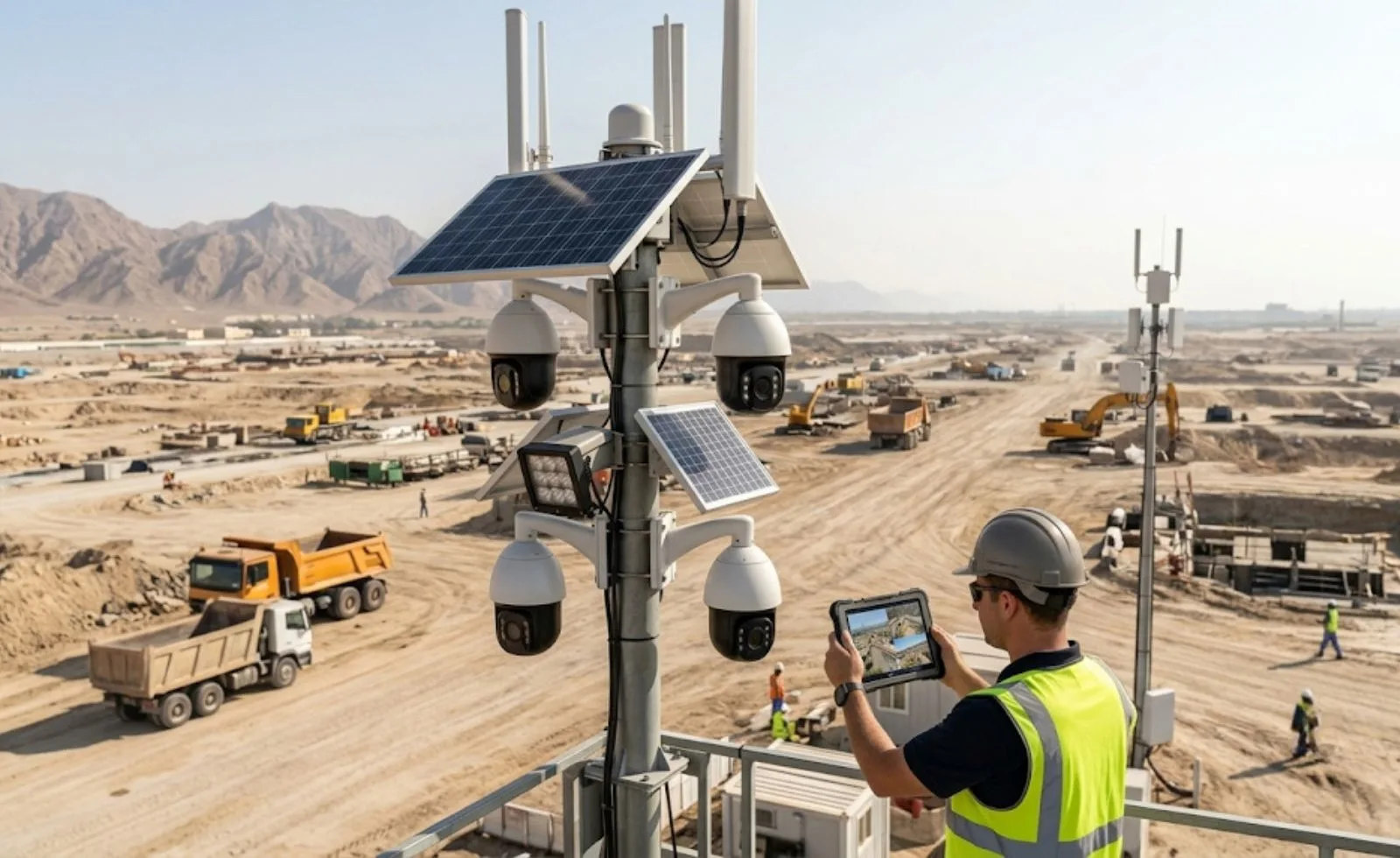
What Is Solar-Powered CCTV?
A solar-powered CCTV camera is a surveillance unit that generates its own electricity through an attached solar panel, stores that energy in a rechargeable battery, and runs independently of the local power grid. Instead of running cables from a distribution board to every camera pole, you mount the camera, angle the panel toward the sun, and it starts working.
Most modern units also transmit footage over a 4G/5G SIM card or Wi-Fi, so there’s no need to lay network cabling either. In practice, this means a single technician can install a fully working camera in under an hour, without an electrician, a trench, or a permit for underground works.
Why Construction Sites Are a Perfect Match for Solar CCTV
Construction sites have a few characteristics that make wired security systems impractical:
- No permanent power in the early stages. Electrical connections are often one of the last things installed on a site, sometimes months after the perimeter fence goes up.
- Constantly changing layout. Site boundaries, material yards, and access points shift as the build progresses, so cameras need to move too.
- Remote or semi-remote locations. Highway projects, pipeline works, and desert developments are frequently far from any grid connection.
- High-value, easy-to-move assets. Copper wiring, generators, fuel, and tools are common theft targets, and criminals often strike during off-hours when there’s no staff around.
Solar CCTV solves all four problems at once. It needs no mains power, it can be relocated in minutes, it works in isolated areas, and it provides round-the-clock recording even when the site is unmanned overnight.
How Solar CCTV Systems Actually Work
A typical solar CCTV unit has four core parts working together:
- Solar panel – Captures sunlight and converts it into electrical energy during daylight hours.
- Battery bank – Stores surplus energy so the camera keeps running through the night and during a stretch of cloudy or dusty days.
- Camera module – Records footage in high resolution (commonly 4K or 8MP today), often with night vision, motion detection, and two-way audio.
- Connectivity module – Sends live footage and alerts to a mobile app or control room using a SIM card or wireless network, so managers can check the site from anywhere.
When motion is detected, many systems only start recording or streaming at that moment, which saves battery power and storage space. Some units also include a siren or flashing light that triggers automatically when someone enters a restricted zone after hours, adding an extra layer of deterrence before a guard or authority even responds.
Key Benefits for Construction Companies
- Theft and vandalism deterrence. A visible camera on a pole is often enough to make an opportunistic thief think twice. Continuous recording also gives you solid evidence if an incident does happen.
- No electrical installation cost. You skip the expense of trenching, cabling, and connecting to the grid — a real saving on large or temporary sites.
- Fast, flexible deployment. Cameras can be mounted on poles, mobile trailers, or temporary towers and repositioned as the project moves through different phases.
- Remote monitoring from anywhere. Site managers, project owners, or head office staff can check live video or recorded clips from a phone or laptop, without visiting the site.
- Lower long-term running costs. Since the system runs on free solar energy, there’s no ongoing electricity bill tied to the cameras themselves.
- Safety and compliance support. Footage can help confirm that PPE rules, restricted-zone access, and safe working practices are being followed, which is useful during audits or after an incident.
- Environmentally friendly operation. No diesel generators, no extra load on the grid, and no emissions from powering the cameras.
Why Oman-Based Construction Sites Benefit Even More
Oman’s climate and terrain make it a particularly good fit for solar surveillance. The country enjoys high year-round sunshine, which means solar panels can generate strong, consistent power almost every day of the year, even during the shorter daylight hours of winter months.
At the same time, Oman’s infrastructure and mega-projects, from coastal developments to inland industrial zones and highway corridors, often stretch across large, exposed areas where running mains power to every corner of the site is neither practical nor cost-effective. Add in Oman’s intense summer heat, occasional dust storms, and remote worksites near mountains or desert stretches, and it becomes clear why a rugged, self-powered, wireless camera system is far more reliable than a traditional wired setup.
For contractors and project managers looking into cctv solutions in Oman, solar-powered systems offer a practical answer to exactly these local conditions: extreme heat, dust exposure, unreliable temporary power, and sites spread across long distances. Companies offering CCTV services in Oman increasingly recommend solar units for exactly this reason, they hold up better in harsh weather and need far less maintenance than cabled alternatives.
What to Look for Before Buying
Not every solar CCTV camera is built the same way. Before choosing a system for a construction site, check the following:
- Resolution: 4K or at least 8MP footage makes it much easier to identify faces, vehicle plates, and small tools in recorded video.
- Battery capacity: Look for a battery that can hold enough charge to run for several consecutive cloudy or dusty days without sunlight.
- IP rating: An IP66 or IP67 rating means the camera can handle rain, dust, and heat without damage, essential in Oman’s climate.
- Connectivity type: 4G SIM-based cameras work well on remote sites with no Wi-Fi router nearby.
- Night vision range: Infrared or full-color night vision matters most, since theft and trespassing usually happen after dark.
- Motion alerts: Real-time push notifications let you respond immediately rather than reviewing footage the next morning.
- Mounting flexibility: Choose a unit that can be fixed to a pole, tower, or mobile trailer, so it can move with the site.
Installation: What to Expect
Setting up solar CCTV is far simpler than a wired system, but a few steps still matter for good performance:
- Site survey – Identify entry points, material storage areas, equipment yards, and blind spots.
- Panel positioning – Angle the solar panel to face the direction of maximum sunlight, avoiding shade from cranes, scaffolding, or nearby buildings.
- Height and angle – Mount cameras high enough to avoid tampering while keeping a clear view of the target area.
- Network check – Confirm signal strength if using a SIM-based connection, especially on remote or rural sites.
- App setup – Connect the system to a monitoring app so authorized staff can view footage and receive alerts.
- Ongoing checks – Periodically clean the solar panel and camera lens, since dust build-up (common in Omani conditions) can reduce charging efficiency and image clarity.
Many providers offering CCTV Camera service in Oman also include installation, panel positioning, and periodic maintenance as part of their package, which removes the guesswork for contractors who want a working system without managing it themselves.
Common Challenges (and How to Handle Them)
- Extended cloudy or dusty periods: Choose a system with a larger battery buffer to cover several low-sunlight days.
- Signal dead zones: Test connectivity before final installation, or use a signal booster where needed.
- Panel shading: Reposition or trim obstructions that block direct sunlight during peak hours.
- Dust accumulation: Schedule a simple wipe-down of panels and lenses every few weeks to maintain performance.
- Theft of the camera unit itself: Use tamper-proof mounting brackets and place units out of easy reach.
None of these issues are deal-breakers, they’re simply factors to plan for during setup.
Cost-Benefit Analysis Table (CAT)
The table below gives a simplified snapshot comparing solar CCTV against traditional wired CCTV for a typical mid-sized construction site.
Factor | Solar-Powered CCTV | Traditional Wired CCTV |
Installation time | Hours | Days to weeks |
Electrical work needed | None | Cabling, trenching, connection |
Relocation flexibility | High, move with the site | Low, fixed once wired |
Running cost | Minimal (free solar energy) | Ongoing electricity cost |
Suitability for remote sites | Excellent | Poor without grid access |
Performance in Oman’s heat/dust | Strong, with regular cleaning | Cabling and connectors can degrade faster |
Upfront cost | Moderate (battery + panel + camera) | Lower per camera, but higher total project cost |
Downtime risk | Low (self-powered) | Higher (power cuts affect system) |
Reading the CAT: For short-term, remote, or evolving construction sites, solar CCTV usually wins on flexibility, speed of deployment, and total cost over the life of the project, even if the per-unit price looks slightly higher at first glance.
Frequently Asked Questions
Do solar-powered CCTV cameras work at night?
Yes. The battery stores energy collected during the day, and most units include infrared or color night vision so recording continues after dark.
How long does the battery last without sunlight?
It depends on the battery size and camera settings, but many modern systems can run for 3–7 days on stored charge alone, even without fresh sunlight.
Can solar CCTV handle Oman's hot summers?
Yes, as long as the unit has a good IP rating and heat-resistant components. Reputable systems are designed to operate in high-temperature, dusty environments.
Do I need Wi-Fi to use solar CCTV on a construction site?
No. Most solar CCTV cameras use a 4G SIM card for connectivity, which works well on remote sites without a local internet connection.
Is solar CCTV more expensive than traditional CCTV?
The camera unit itself may cost a bit more upfront, but you save significantly on installation, cabling, and electricity, making it more cost-effective over the life of a project.
Can the cameras be moved as the construction site changes?
Yes. Since there’s no cabling involved, solar cameras can be repositioned or relocated to a new area of the site within minutes.
How often does the solar panel need cleaning?
In dusty environments like many parts of Oman, a light wipe every 2–4 weeks helps maintain charging efficiency and picture clarity.
What resolution should I choose for construction site monitoring?
4K or 8MP is recommended for clear identification of faces, vehicles, and small equipment, especially for evidence purposes.
Can solar CCTV send alerts if someone enters the site after hours?
Yes. Most systems support motion-triggered alerts sent directly to a phone or monitoring app, often paired with a siren or flashing light.
Who should I contact for solar CCTV installation in Oman?
Look for a provider experienced in cctv solutions in Oman who can assess your site conditions, recommend the right system, and handle installation and maintenance.
Final Thoughts
Solar-powered CCTV has moved from a “nice-to-have” to a practical necessity for modern construction sites. It removes the biggest barrier to security on a jobsite, the lack of power, while giving project managers real-time visibility into what’s happening on site, day or night. For contractors working in Oman, where sunshine is abundant but grid access on remote sites often isn’t, solar CCTV is one of the most sensible investments you can make to protect materials, equipment, and workers from day one of the project.